
Paper ROI vs Liquid ROI: How to Evaluate Crypto Presales Before TGE
Paper ROI can make a crypto presale look profitable before TGE, but liquid ROI shows what is actually unlocked, accessible and exposed to market risk.

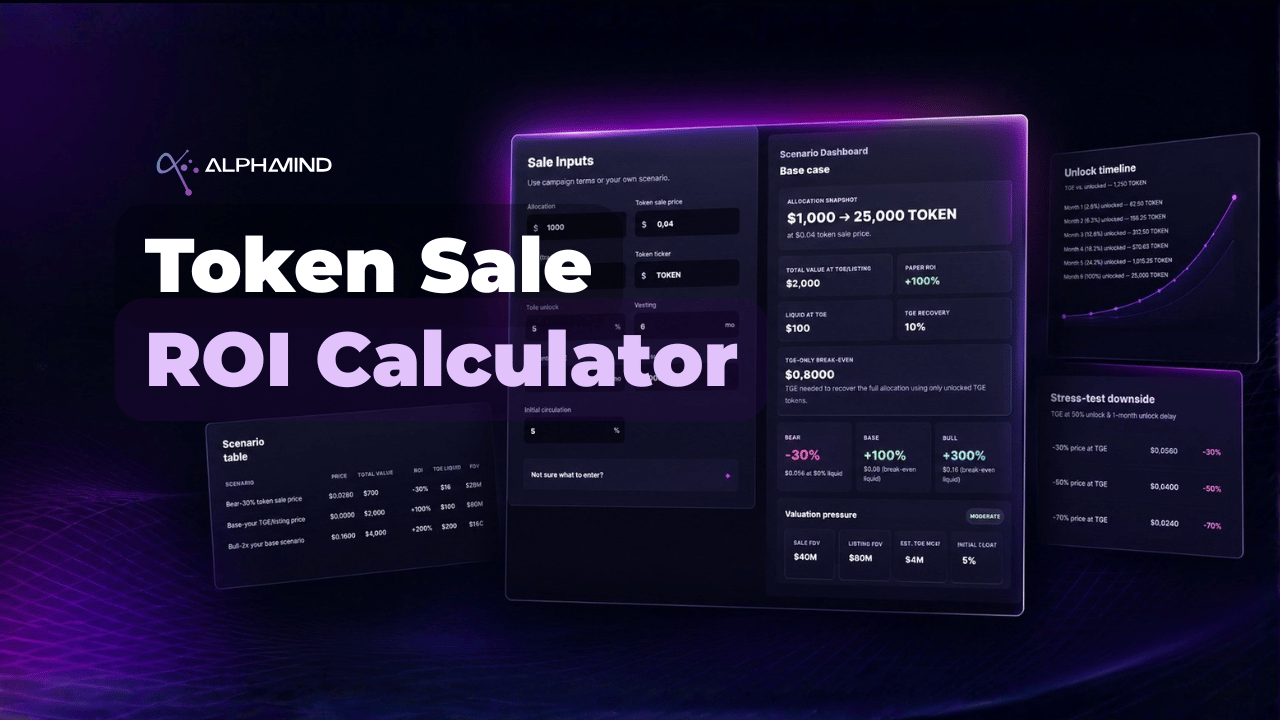
Paper ROI can make a token sale look simple. You enter early, the token lists higher, and the spreadsheet says you are up. But in real presales, vesting, TGE unlocks, FDV and liquidity decide how much value you can actually access.
That is why AlphaMind treats presale ROI as a liquidity question, not just a price-multiple question. The free AlphaMind Token Sale ROI Calculator helps users and crypto investors model allocation size, sale price, TGE/listing price, unlock percentage, vesting, FDV, liquid-at-TGE value and break-even before joining a token sale.
TL;DR
A token sale ROI calculator helps users model allocation size, sale price, TGE/listing price, unlock percentage, vesting, FDV and break-even before joining a presale. The key is to separate paper ROI from liquid-at-TGE value: a sale can look profitable on paper while only a small part of the allocation is unlocked at launch.
Why This Matters More in 2026
Token unlocks are not a small tokenomics detail anymore. They are one of the recurring supply events retail users now have to watch before and after TGE.
In June 2026, market coverage highlighted roughly $293 million in scheduled token unlocks in a single week. In May 2026, other market reports pointed to billions in cliff unlocks across major assets. That does not mean every unlock causes a dump, but it does mean unlock timing, liquidity and demand absorption matter.
This is why crypto presale ROI should not be modeled only as entry price versus listing price. A token can show attractive paper ROI while most of the allocation is locked, the FDV is already high, or initial circulation makes market cap look smaller than the real valuation pressure.
Sources: TokenPost reported roughly $293M in scheduled token unlocks for June 1-7, 2026, while CryptoTimes covered approximately $2.24B in May 2026 cliff unlocks.
What Is a Token Sale ROI Calculator?
A token sale ROI calculator estimates possible presale outcomes by combining allocation size, sale price, TGE/listing price, unlock percentage, vesting and token supply. The most important output is not only paper ROI, but how much value is actually liquid at TGE and what price is needed to break even on unlocked tokens.
In a normal token sale, the basic question is not just "what if the listing price is higher than my sale price?" A better question is: "how much of my allocation is actually unlocked, and what valuation does this price imply?"
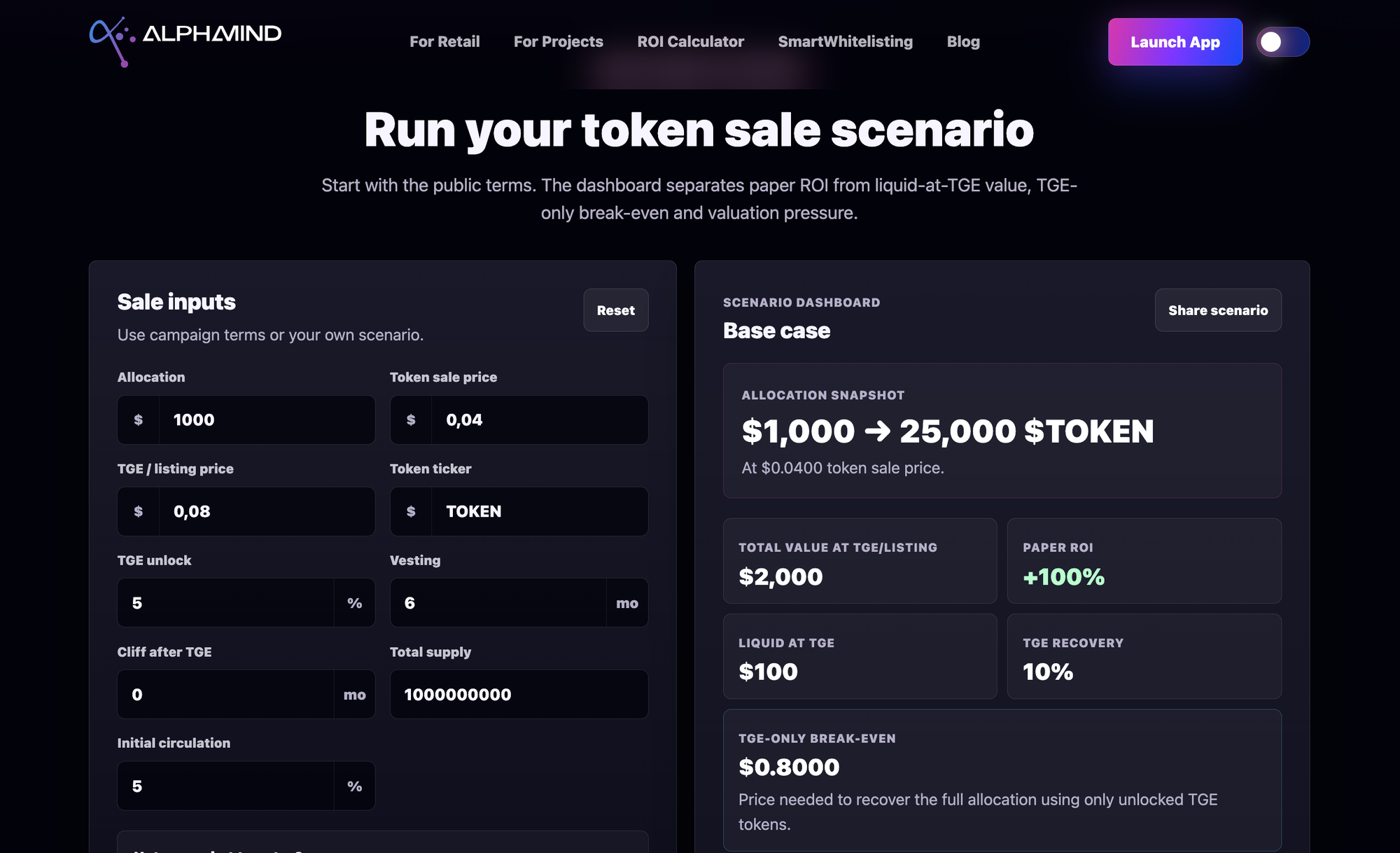
AlphaMind's calculator is built around that more practical question. It models:
- Allocation size
- Token sale price
- TGE or listing price
- TGE unlock percentage
- Vesting duration
- Cliff after TGE
- Total token supply
- Initial circulation
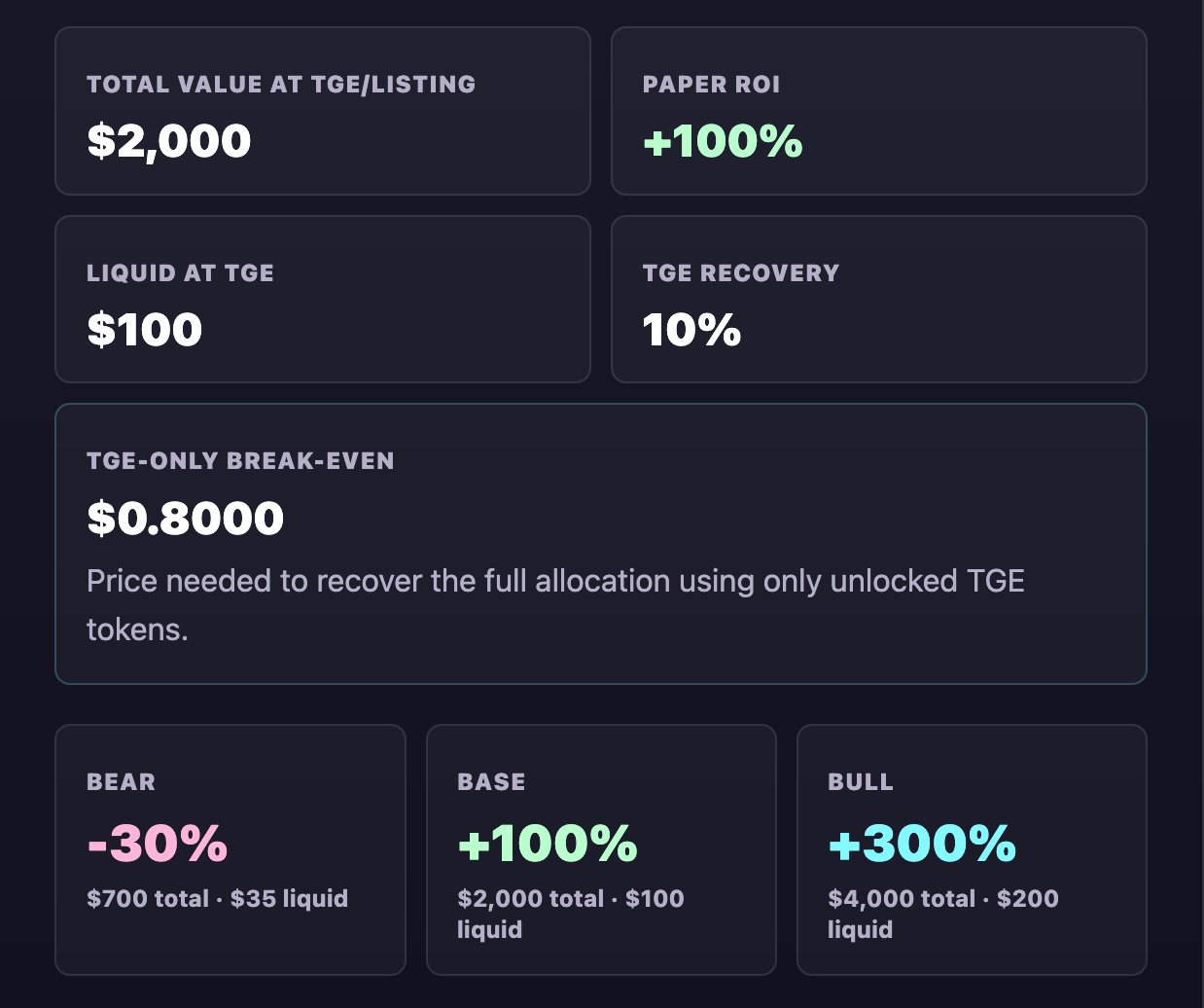
- Paper ROI
- Liquid-at-TGE value
- TGE-only break-even
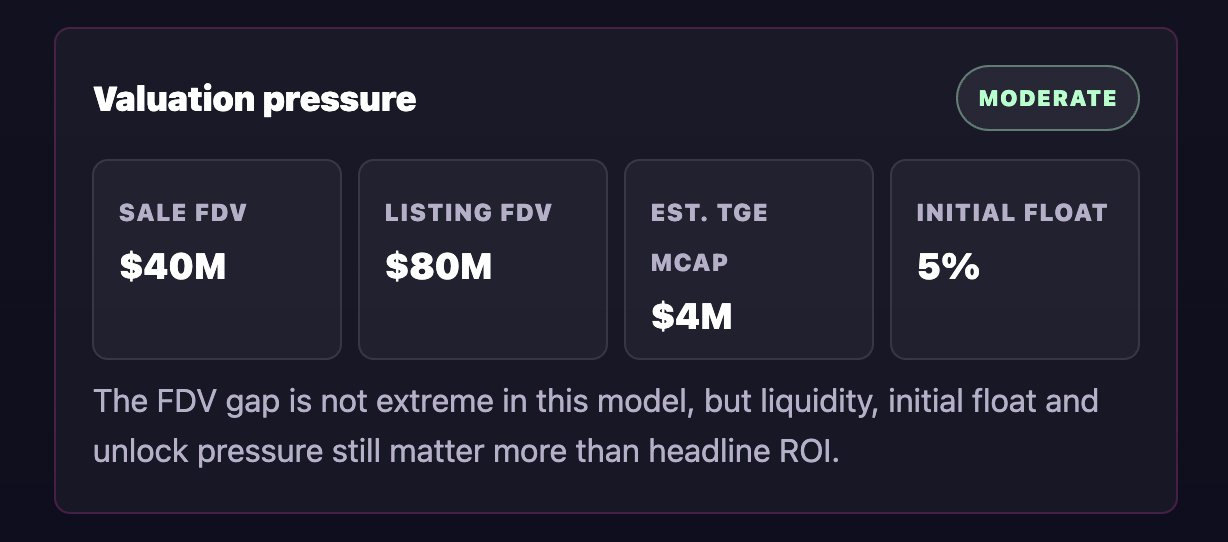
- Sale FDV, listing FDV and estimated TGE market cap
Why Paper ROI Is Not the Same as Liquid ROI
Paper ROI shows the value of the full allocation at a modeled token price. Liquid-at-TGE value shows the portion that is actually unlocked at launch. These numbers can be very different.
For example, if you invest $1,000 at a $0.05 token sale price, you receive 20,000 tokens. If the token lists at $0.10, the full allocation is worth $2,000 on paper. That looks like +100% ROI.
But if only 20% unlocks at TGE, only 4,000 tokens are liquid at launch. At $0.10, that liquid portion is worth $400. The paper ROI is +100%, but the TGE recovery is only 40%.
That is why token sale investors should model both paper ROI and liquid-at-TGE value before committing.
How to Calculate Token Sale ROI
The basic token sale ROI formulas are:
Tokens received = Allocation / Token sale price
Total modeled value = Tokens received x TGE/listing price
Paper ROI = (Total modeled value - Allocation) / Allocation x 100
Liquid at TGE = Tokens received x TGE unlock % x TGE/listing price
TGE-only break-even = Allocation / TGE unlocked tokens
These formulas are simple, but they become harder to reason about once vesting, cliff periods, FDV and initial circulation enter the picture. That is where a calculator becomes useful.
You can model your token sale ROI directly in AlphaMind launchpad instead of rebuilding the same math in a spreadsheet.
Why TGE Unlock and Vesting Matter
TGE unlock determines how much of your token allocation becomes available at launch. Vesting determines how the rest unlocks over time. If the TGE unlock is small, most of your position remains exposed to future market movement.
This matters because a high headline ROI can hide low short-term liquidity. A token may trade above the sale price at launch, but if most of your allocation is locked, you may not be able to recover your original allocation from the unlocked tokens.
For retail users, the most useful question is often:
What price would the token need at TGE for my unlocked portion to recover my full allocation?
That is the purpose of TGE-only break-even.
FDV, Initial Circulation and Valuation Pressure
FDV, or fully diluted valuation, is token price multiplied by total token supply. It helps users understand what valuation a sale price or listing price implies for the full network.
Estimated TGE market cap is different. It uses the circulating portion at TGE:
Estimated TGE market cap = Listing FDV x Initial circulation %
This distinction matters because low initial circulation can make market cap look small while FDV is already high. A token can appear cheap on a market-cap basis while still pricing the full network aggressively.
Example Scenario
Here is a simple token sale scenario:
Allocation: $1,000
Sale price: $0.05
TGE/listing price: $0.10
TGE unlock: 20%
Vesting: 6 months
Cliff: 0 months
Total supply: 1,000,000,000
Initial circulation: 15%
The modeled outputs are:
Tokens: 20,000
Total value: $2,000
Paper ROI: +100%
Liquid at TGE: $400
TGE recovery: 40%
TGE-only break-even: $0.2500
Sale FDV: $50M
Listing FDV: $100M
Estimated TGE market cap: $15M
The important lesson is that the headline result and the liquid result are not the same. The full modeled value is $2,000, but only $400 is liquid at TGE under a 20% unlock.
Run the same inputs in the Token Sale ROI Calculator.
How to Use AlphaMind's Token Sale ROI Calculator
To use AlphaMind's calculator:
- Enter the allocation you plan to commit.
- Enter the token sale price from the campaign terms.
- Enter your TGE/listing price scenario.
- Add TGE unlock and vesting assumptions.
- Add total supply and initial circulation if available.
- Compare paper ROI, liquid at TGE, break-even and FDV.
- Share the scenario if you want to discuss assumptions with others.
You can run your token sale scenario for free on AlphaMind.
For campaigns using pre-sale demand validation, AlphaMind also supports SmartWhitelisting, which helps projects measure committed retail demand before the actual sale opens.
For founders planning a retail-facing sale, AlphaMind's launch application page explains how teams can request a launch review.
When the Calculator Should Make You More Cautious
A calculator does not tell you whether a token sale is good or bad. It helps you see where the assumptions may be fragile.
Be more cautious when:
- FDV is high for the project's stage.
- TGE unlock is low.
- Initial circulation is low while listing FDV is high.
- Vesting is long and most of the position remains locked.
- TGE-only break-even is far above the listing scenario.
- Liquidity assumptions are unclear.
- The project explains upside clearly but does not explain unlock pressure.
None of these signals automatically means a sale is bad. They simply show where the risk needs more attention.
FAQ
What is token sale ROI?
Token sale ROI is the modeled return between the token sale price and a future token price scenario. In presales, ROI should be separated into paper ROI and liquid-at-TGE value because not all tokens may unlock at launch.
What is liquid at TGE?
Liquid at TGE is the value of the token allocation that unlocks at token generation event. If only 20% unlocks at TGE, only that portion is available at launch.
What is TGE-only break-even?
TGE-only break-even is the token price needed to recover your full allocation using only the tokens unlocked at TGE. It shows how much pressure the launch price carries if most of the allocation is still locked.
What is FDV?
FDV means fully diluted valuation. It is calculated as token price multiplied by total token supply. In token sales, FDV helps users understand what valuation a sale price or listing price implies.
Is this financial advice?
No. AlphaMind's calculator is an educational modeling tool only. It does not predict listing price, liquidity, token performance, allocation outcomes or market results.
Can I use it for any presale?
Yes. You can use the calculator for any token sale or presale where you know the allocation, sale price, unlock schedule and supply assumptions.
Does AlphaMind predict listing prices?
No. The TGE/listing price field is your own scenario. The calculator helps you test assumptions; it does not predict future prices.
Final CTA
Before joining your next token sale, run the numbers first.
Use the free AlphaMind Token Sale ROI Calculator to model unlocks, vesting, FDV, liquid-at-TGE value and break-even before you commit. sportpesa spaceman live casino at Betika Kenya