
Every Investor Already Has an LLM Tracking Your Token. Manage the Answer.
Every investor researching a token now asks an AI first. ChatGPT, Perplexity and Grok are assembling your project's reputation from Reddit, media coverage & Quora - not your website. Here's how that works, and what crypto founders and investors need to know before the next TGE.
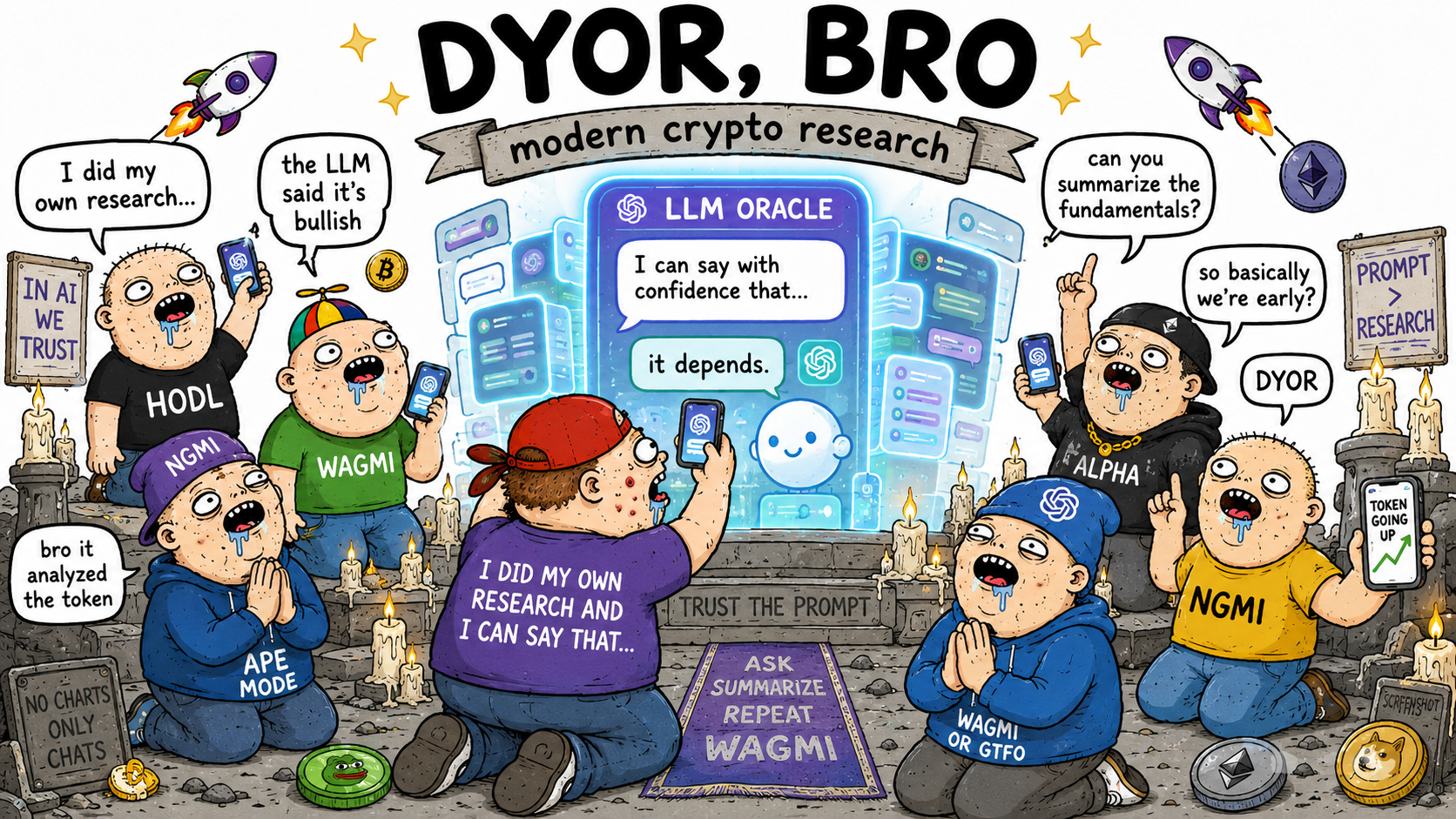
Did you even notice that humans - hodlers, VC funds, potential token investors & users - do not check on your project by reading your website anymore?! Today they point an AI model at it. A fund analyst runs your token through a deep-research agent and gets a sourced brief in minutes. A retail holder asks Perplexity whether you are still worth holding, then asks again a few weeks later. A partner's BD lead runs you through a custom GPT before the call is ever booked.
The model has become a standing analyst on your project, and it reports to everyone except you. Whatever it says is the working truth about your token. You did not write it, you probably have not read it, and for most crypto projects it is either wrong or absent.
I run resident networks on Reddit and other forums for crypto teams. The most common thing we find on an audit is a project that spent six figures on a launch, a KOL round and a slick site, and still gets summarised by ChatGPT in two sentences pulled from a year-old Reddit thread that someone started after losing money. The team never saw the thread. The model treats it as the record.
This is a layer you now have to manage, the same way you manage your cap table or your timeline. You cannot steer what you do not understand, so the rest of this piece is about how a model assembles that answer, and what moves it.
A model is already tracking your project on a schedule
The behaviour shift is the part founders underrate. People used to open ten browser tabs and form their own opinion. Now an agent does the reading and hands them a conclusion, and it does this on a schedule rather than once. Deep-research tools will re-run the same brief on your token next month and the month after, so the answer behaves like a feed rather than a snapshot you can shrug off, and you are either feeding it or leaving it to whoever else showed up.
To manage that feed you have to know where it pulls its material. A model leans on a small set of sources it has learned to trust, and for crypto that set is weighted heavily toward forum discussion. Reddit is the most-cited single source across major AI engines, sitting near 40% citation frequency in the 5WPR AI Platform Citation Source Index 2026, which sampled 680M citations. On Perplexity specifically, Reddit accounts for roughly 24% of citations per the TechEdge AI 2026 study. Inside Google's AI Overviews, Reddit makes up about 44% of the social citations the same study tracked.
The funnel is narrow at the top. The 5WPR index found that the top 15 domains hold about 68% of all AI citation share. A handful of places decide what the machine knows about you, and your domain is almost certainly not one of them.
How to survive in @Grok is it true? era
On crypto Twitter the check is now inside Super Grok chat. Under any post about a project, someone tags the model: "@grok is this true?", "@grok is this legit?" - that's what you see. And you don't see what's happening in Super Grok, try to ask about your project, you gonna be surprised.
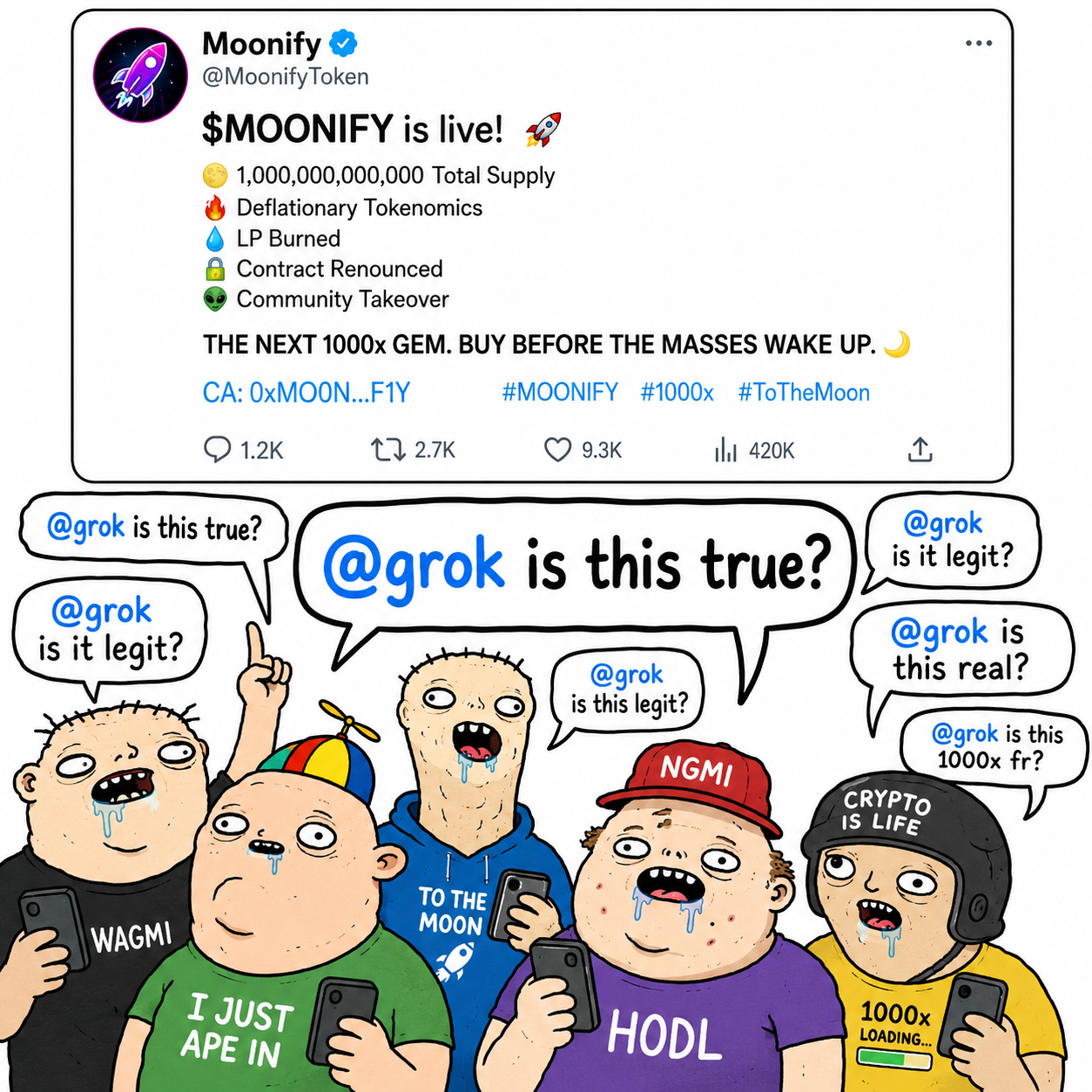
Grok is the one engine tuned on the platform it lives in. It learns from X itself, so the volume and the recency of what gets said about you there shape its answer more directly than they do for any other model. If your name barely appears on X, Grok has little to go on and fills the gap with guesses. If your category is being discussed and your project keeps showing up inside those conversations credibly, Grok has a real body of signal to draw on and answers with it.
That is a volume-and-time problem, and it is where sustained X distribution earns its keep. Real accounts mentioning you in context, KOLs giving the topic weight, the same names recurring across months instead of a single blast. None of this is the listing-week spam burst that every filter clips. The difference is time and context: presence built slowly enough that the model reads it as the normal state of the conversation. The shape we run for launches is a long ramp, roughly three months of contextual buildup before the event, then an active phase through the launch itself. By the time the timeline fills with "@grok is this legit", the model has already read enough to answer for you.
One caveat decides whether any of this works. The volume has to mean something. We tested it, and Grok gives far more weight to a post that actually says something, a real take or a real comparison, than to a hundred one-line replies, even when the substantive post is polished or AI-assisted. The cheap route, paying a quest platform like Zeely or a Galxe-style farm to flood your replies with "LFG" and "gogogo" and "wagmi", produces traffic the model reads as noise and discards. Worse, it makes your conversation look manufactured and hollow, which is the opposite of the signal you are trying to build. Meaningful content at volume moves Grok. Cheap engagement at volume does not, and it can mark you.
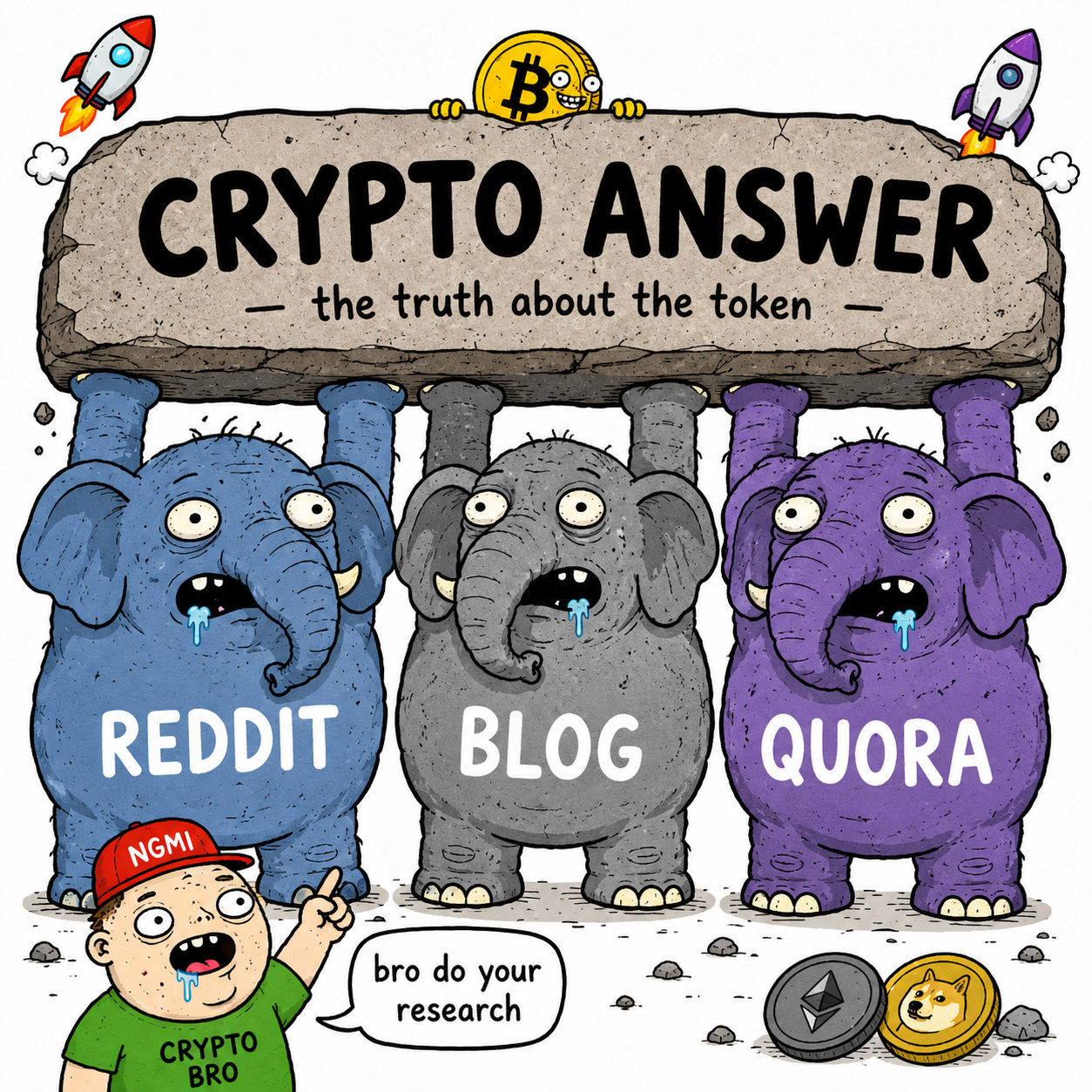
The three elephants that hold up a crypto answer
When a model assembles what it thinks about your project, it skips your landing page. Your site says you are revolutionary and audited and community-first, and the engine has learned that project-owned copy is the weakest witness about a project. It skips your X feed too, because X is not heavily cited by large models such as Gemini, GPT or Perplexity.
It quotes the places where other people talked about you without being paid to. For crypto, three surfaces carry almost every answer:
- Editorial and blog articles. Independent write-ups, category roundups, news coverage. A model treats a third-party article as a credible read on a project, which is exactly why an earned guest post or a genuinely useful explainer outranks your own homepage as a source. You need to buy articles from domains that Google considers trusted. 95% of crypto domains are not.
- Reddit threads. The single most-cited surface for crypto, where actual holders argue a project out in public, with transaction hashes and screenshots the model reads as evidence.
- Quora answers. The underrated one. Long-form Q&A maps straight onto the "is X legit" and "X vs Y" questions buyers actually type, and the engines reward a clean question-and-answer match.
So the answer your investor reads is assembled from whatever already exists about you across those three. If the only thing there is one angry post-mortem from your last depeg scare, that is your reputation. If there is nothing at all, the model says it cannot find much (which reads as "avoid") or pattern-matches you to the nearest scam it does know.
You are building a brand for the machine now
Here is the part that reframes the whole budget. Grok learns you from X over time. Perplexity, ChatGPT and Google's AI Overviews work differently, but they land in the same place. They answer from a corpus that has to contain enough about you and has to have been crawled and ingested before anyone asks. An article you publish today is not quoted tomorrow. It gets indexed, accumulates signals, corroborates against other sources, and only then becomes the thing the model reaches for. Every engine, for its own reason, needs time and needs data.
The task runs deeper than a launch-week push. It means proving, over months and across the three surfaces, that you are real and that you are legit, in a story consistent enough that the model can repeat it back. This is the shift founders miss. You are no longer only building a brand for your audience, who read tone and vibes. You are building one for the machine, which reads repetition and corroboration. If five independent threads, two editorial pieces and a Quora answer describe you the same way, the model states it as fact. If your positioning is different on every surface, the model has nothing stable to say and defaults to caution.
That is why the warm-up starts at least three months before the event. The data has to exist and be consumed before the queries spike, and that does not compress into the week of the listing. Build the positioning for the machine early, keep it consistent, and by the time buyers go asking, the answer is already sitting there waiting for them.
Why most crypto projects are invisible or misread
Almost every team we audit lands in one of two failure modes, and they look opposite but they share a root.
The first project never showed up. They poured budget into the launch and the KOL push, treated Reddit and forums as beneath them, and assumed the site plus CT would carry the narrative. The forums stayed empty of any signal in their favour. When a single critic posts, that critic owns the record by default. The model has nothing else to weigh against it. They ran the cheap version. Fresh accounts, copy-paste praise, a coordinated burst of "great project ser" the week of the listing, sometimes a quest farm paid to pad the replies. Reddit's spam systems clip most of it, the rest gets downvoted into invisibility, and the AI engines were already trained to filter that pattern out. A wall of low-karma identical praise is the exact signal a citation model is built to ignore. The project spent money creating content the machine treats as noise.
The second project started the warm-up roughly three months before the listing. A pool of more than a hundred aged accounts already present in the relevant subreddits, posting things that actually said something, real questions and real comparisons rather than praise. A couple of KOLs gave the topic weight on X across those months, and a few canonical threads were built to be quoted. By listing week, ChatGPT, Perplexity and Grok all answered the "is it legit" question with the same coherent story, because the data had been sitting there for months and lined up across every surface.
Same launch budget, comparable product, opposite machine answer. The difference was time, and whether the presence meant anything.
There is a real volatility risk on top of this that founders should know about. AI citation sourcing is not stable. The same 5WPR index recorded ChatGPT's Reddit citation share dropping from around 60% to around 10% in roughly six weeks after a single Google parameter change. The weighting moves. What does not move is the underlying preference for earned third-party discussion over self-published marketing. Betting on that preference is safe. Betting on one exact percentage is not.
Ads don't get cited. Earned presence does.
This is the distinction that costs teams the most money, so it is worth being concrete about it. An ad impression and a paid shill post both feel like "we did marketing". To the engine that decides your answer, neither one exists as a quotable source. A genuine thread where residents discuss your project does exist, gets cited, and keeps getting cited for years.
Here is the split as we see it across the campaigns we run.
| What you bought | Gets cited by AI engines? | Survives a moderator and downvote sweep? | What the buyer actually sees |
|---|---|---|---|
| Reddit / X ads | No. Ads are not in the citation corpus | Not applicable, the spend ends and the impression is gone | A promoted post they scroll past |
| Shill burst (fresh accounts, listing week) | No. The pattern is filtered as spam | Rarely. Most gets removed or buried within days | Either nothing, or a removed-post graveyard |
| Quest-platform engagement (Zealy, quest farms) | No. Reads as noise and gets discarded | Buried, and it can flag your account | A wall of "LFG" and "gogogo" nobody trusts |
| KOL paid posts | Sometimes on X surfaces like Grok, weakly elsewhere | The post stays, the credibility does not transfer | A disclosed-or-not promotion they discount |
| Sustained, in-context X presence | Feeds Grok over time as real signal | Yes, it reads as the normal conversation | A project the timeline already talks about |
| Earned forum presence | Yes. Discussion threads are the most-cited crypto source | Yes, when it reads as real participation | A multi-voice thread that answers the question |
Ads buy attention for exactly as long as the budget runs. The moment you stop paying, you vanish from the surface and from the model's view of you. A thread that earned its place keeps ranking and keeps getting quoted long after the campaign ends. One pays rent, the other builds an asset. For a token whose narrative has to survive past the listing pump, that difference is the whole game.
AI DYOR checklist before joining a token sale
Before you take an allocation in any token sale, run the project through a clean AI research flow.
Ask Perplexity, ChatGPT, Gemini and Grok:
- Is this project legitimate, and what evidence supports that?
- What are the main risks around the team, tokenomics, unlocks, traction and market timing?
- What independent sources mention the project?
- Are there real discussions from users, builders or investors, or only project-owned announcements?
- How does it compare with the closest alternative in the same category?
- What would make this allocation risky even if the project is real?
Then check the sources, not only the summary. AI answers can be useful, but they can also repeat stale, biased or incomplete information. A clean DYOR process means reading the underlying sources, checking the token sale terms, understanding vesting and unlocks, and deciding whether the risk fits your own portfolio.
Not financial advice. Always do your own research.
What a founder should actually do
Start by reading your own answer. Open Perplexity in a clean window right now. Ask it the three questions a cautious investor would ask about your project: is it legit, what are the risks, how does it compare to the obvious alternative. Read what comes back and note which sources it cites underneath. That is your real first impression, and most founders have never looked at it.
Then decide who is going to populate the rooms that answer those questions. The work is slow and it does not look like marketing, which is exactly why it works. It means having credible, aged participants present in the subreddits and forums where your category gets discussed, talking about the space honestly most of the time, and earning the standing to mention your project when it is genuinely relevant.
One canonical comparison thread, written to be quotable, with real detail and real disagreement in the replies, will outperform a thousand shill posts because the engine can actually use it. The same logic runs on Quora and in editorial coverage. Reddit carries the most weight for crypto, so it is where we concentrate first.
This is the part we do for crypto teams: we earn a presence in the Reddit threads that AI engines actually cite, through residents who have been in those communities long enough that their mention of you reads as participation rather than promotion. If you are heading into a token launch and want the forum footprint to be in place before the listing, the packaged version of that work is built for the launch window.
A caveat, because this matters. None of this rescues a weak product or a broken token. Earned forum presence makes a fair project legible and defends a good one from a single loud critic. It cannot manufacture a reputation that the underlying thing does not deserve, and if you try to use it that way the threads turn on you faster than any ad ever could. The mechanic rewards projects that can survive an honest conversation. If yours can, the work is to make sure that conversation is actually happening where the model is reading.
Quests are not just engagement. They are pre-launch proof.
For retail investors, AI research is one layer of DYOR. Another useful layer is checking whether a project can generate real community participation before TGE: educational quests, launch research, project discussions, wallet-based actions and transparent campaign activity.
For founders, this is why a token launch should not rely only on KOL posts or listing-week hype. A structured launch campaign can help users understand the project, complete meaningful actions and create a clearer public footprint before allocations open.
AlphaMind campaigns are educational and informational. Token sales and quests involve risk; always read the project terms and do your own research.
Common questions (FAQs)
Does my landing page or whitepaper influence what ChatGPT says about my token?
Far less than you would hope. Project-owned pages are treated as low-trust witnesses about the project itself. The engines lean on third-party discussion, and for crypto that means forum threads, editorial articles and Quora more than anything you publish on your own domain.
How does Grok fit into this, if it is different?
Grok is trained on X, so it weights the volume and recency of what is said about you on the timeline more than the other engines do. That is why sustained, in-context X presence and KOL weight over months move it, while a single listing-week blast does not. The forum and editorial work moves ChatGPT, Perplexity and Google AI Overviews; the X work moves Grok. Most launches need both.
Can I just buy upvotes or run a shill push to fix a bad AI answer?
No. Coordinated praise from fresh accounts is the exact pattern the citation models were trained to discard, and Reddit's own systems remove or bury most of it. You spend money producing content the machine ignores, and you risk a moderator sweep that leaves a removed-post trail that looks worse than silence.
How long until this changes the answer?
In our practice the forum threads start surfacing in weeks and compound over months. The Grok side wants a longer runway, which is why we run roughly three months of buildup before a launch. The better placements keep getting cited long after the active work stops.
If you want to know what your own answer looks like before you do anything else, go run those three Perplexity queries. The gap between what you think the model says and what it actually says is where the work starts.
If you use AlphaMind to discover upcoming launches and join token sales, do the same exercise before every allocation: read the project page, check the sale terms, compare the AI answers, and look at the sources behind them. The goal is not to find a perfect answer. The goal is to avoid blind decisions before a TGE.
Explore current and upcoming token sales on AlphaMind, review project materials, and use AI research as one more layer of your DYOR process. Follow us on X and join the community on Telegram or Discord for live launch updates.