Iran Conflict & Your Portfolio: What War Economics Mean for Your Money in 2026
War tests portfolios: US-Iran conflict drives oil prices up, crypto down, and uncertainty everywhere. Here’s what’s actually happening and how retail can navigate to prevent wipeouts.

Author: Hima Eltegany
War isn’t abstract geopolitics when oil spikes 21% in two days.
It’s not background noise when your heating bill jumps 30% or shipping costs double overnight.
And it’s definitely not “someone else’s problem” when every asset class in your portfolio starts moving at once - some up, some down, all violently.
The U.S.–Iran conflict that escalated in the latest days isn’t just a headline. It’s a stress test for every investment decision you made in 2025. And whether you’re holding stocks, metals, crypto, or cash, the next few months will look different than what most people planned for.
This article breaks down what’s actually happening to markets, what it means for retail investors, and what you can realistically do about it.
1. Oil: The Instant Supply Shock
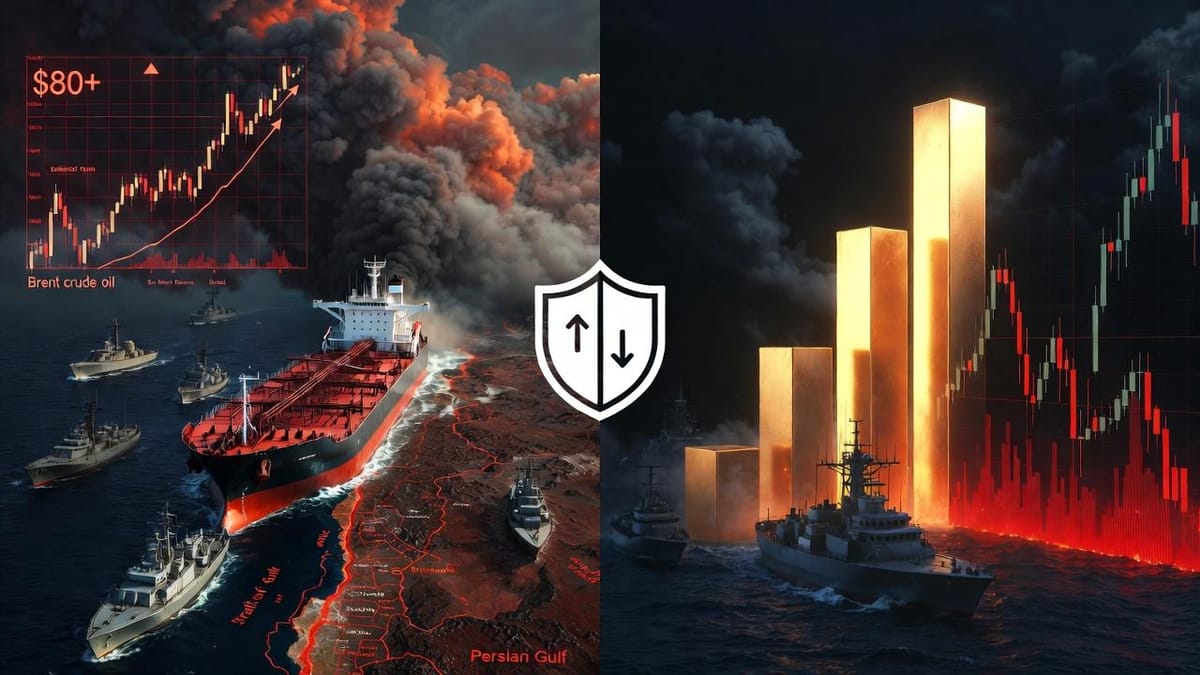
The Strait of Hormuz handles ~20% of global oil trade and LNG. When it's under threat, markets don't "wait and see." They reprice risks immediately.
Recent data shows:
- Brent crude spiked above $80+ per barrel as energy supply concerns climbed. (Le Monde.fr)
- Fears of deeper disruption have pushed analysts to consider levels above $100 per barrel if the situation persists. (Barron's)
This isn't a minor blip - it's energy risk getting repriced in real time.
2. Europe's Gas Shock: The Hidden Tax on Everyone
While oil grabs the spotlight, European gas (TTF benchmark) has spiked as much as ~45% due to LNG supply disruptions tied to the conflict.
Higher energy = higher inflation = trickier rate policies = more pressure on risk assets, including crypto.
This is how geopolitics turns into portfolio math.
3. Gold: "Flight-to-Safety" Isn't a Meme - It's a Reflex
In uncertainty spikes, money flees to perceived safety. Gold does what it's supposed to: act as ballast when stocks and crypto wobble.
Spot gold is rallying toward $5,100+, benefiting from the chaos. It's not always the perfect hedge, but the behavior is reliable—portfolios scramble for stability.
4. Dollar + Rates: Why Crypto Suffers in "Risk-Off" Weeks
Here's the tough pill for crypto holders: Crypto is still a high-beta risk asset. In risk-off modes, it's often sold first, questions later.
Mix in Trump's push for Fed rate cuts amid fresh inflation from energy, and you get a cocktail where liquidity can vanish in hours.
That's why BTC can feel "dead" while oil and gold scream higher. Bitcoin is hovering around $70,000, down from recent highs, as volatility bites.
Inflation Pressures Ripple Across Economies
Central bankers are watching closely. The European Central Bank has warned that a prolonged Middle East conflict could lead to higher inflation and weaker growth, driven in large part by rising energy prices. (Reuters)
This dynamic creates a dilemma:
- Higher inflation increases pressure on central banks to keep rates elevated.
- Elevated rates can dampen economic activity and growth assets such as equities.
- Geopolitical risk may reduce appetite for rate cuts in 2026.
Investors should think ahead about real returns rather than nominal yields, and consider inflation-protected or real assets in their allocations.
Precious Metals: Haven Flows and Profit Taking
In times of geopolitical uncertainty, gold and silver often attract safe-haven demand - and 2026 has been no exception.
Recent market reactions show:
- Gold rallied toward $5,300–$5,400/oz amid tensions. (Mitrade)
- Silver also saw renewed demand, though more volatile due to its industrial component. (mint)
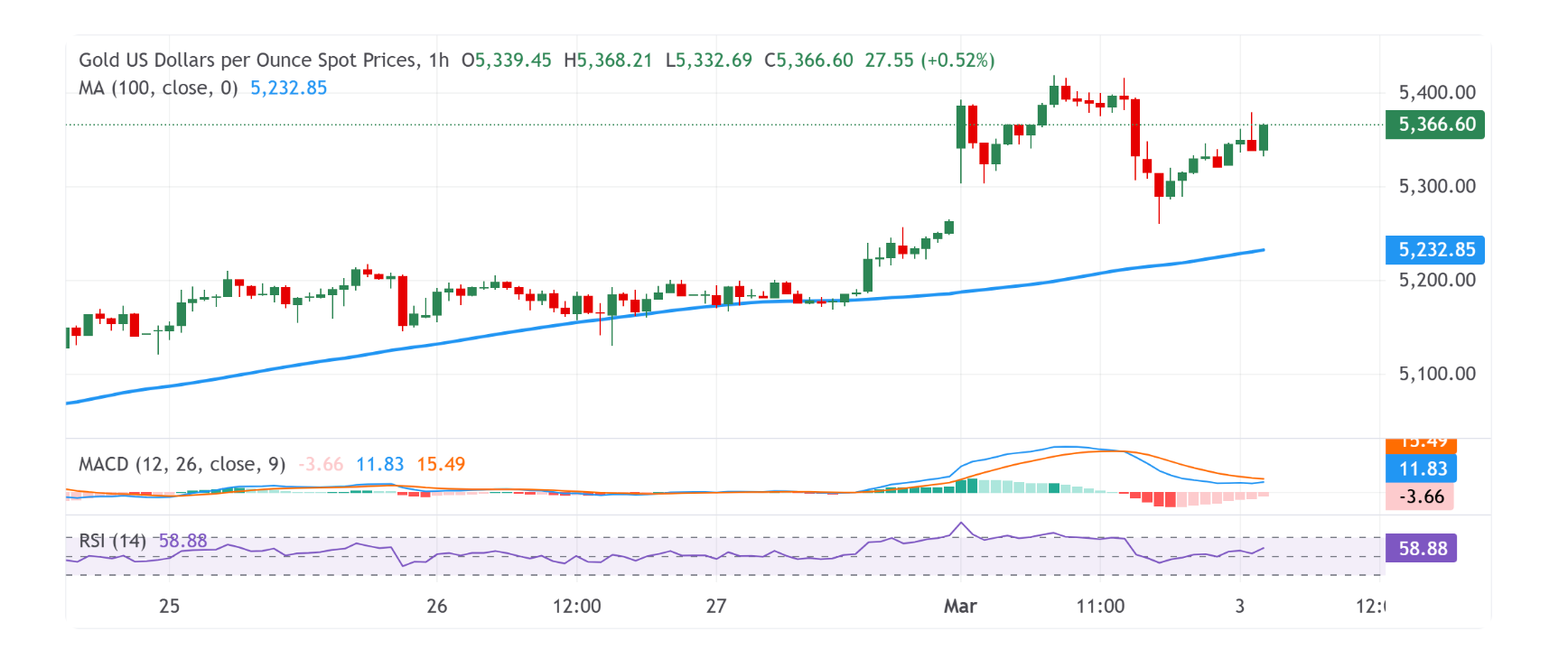
That said, precious metal prices have sometimes retraced after initial spikes, suggesting mixed signals from markets balancing haven buying against strong US dollar and rate considerations. (Reuters)
Investor takeaway:
Gold and silver remain core diversifiers, but volatility is heightened. These markets may offer portfolio ballast, yet timing matters - consider staged allocations rather than lump sums.
Stocks and Risk Assets: A Flight to Safety
Equity markets, particularly in the Middle East and emerging regions, have shown weakness as energy costs rise and inflation risks deepen.
Global indexes - including Asian and European benchmarks - have experienced sell-offs correlated with the conflict’s intensity.
In risk-off environments, investors often shift from growth assets toward traditional havens such as:
- US Treasuries
- Gold & silver
- Defensive sectors (utilities, consumer staples)
Diversification remains critical.
Broader Economic Impacts Beyond Commodities
High energy prices don’t just affect the price at the pump — they have second-round effects:
- Higher manufacturing costs
- Increased freight and insurance expenses
- Compressed consumer spending
- Pressure on emerging market currencies and balances (Reuters)
This is not just a “war premium” trade — it has real impacts on growth, borrowing costs, and market confidence.
What a Retail Investor Should Actually Do
First rule: don’t confuse action with control.
The biggest mistake right now is trying to “out-trade the macro” with a 10-minute attention span.
Your real job is simple: don’t get wiped out.
Practical Survival Allocation (not advice, just a framework)
- Liquidity buffer — so you’re never forced to sell at the bottom
- Defensive bucket — assets that hold up when everything else drops (gold, short T-bills, stable value)
- Long-term conviction positions — your highest-conviction bets, but sized responsibly
- Zero excess leverage — volatility is already doing plenty of damage
Where T-Bills Fit (Yes, Even for Crypto Folks)
If you've got idle cash, parking some in short-term US Treasury bills isn't boring -it's smart. They yield something (around 4-5% currently) and stay liquid when everything else storms.
T-bills won't beat inflation if oil keeps spiking, but they're safer than equities in drawdowns and better than zero-yield cash.
What This Means for Crypto (& Token Sales)
In stressed markets, retail doesn’t disappear - it gets selective.
- Less buying on "hype."
- Harder questions on terms, unlocks, valuations, and real demand.
- "10k followers" stops being a proxy for interest.
- Projects with provable metrics stand out.
Yes, hype and follower counts stop working. Real demand, solid tokenomics, and actual community traction start standing out.
That’s exactly why tight, high-signal communities matter more than ever right now.
At AlphaMind we keep it practical for retail:
- Real-time market notes without doomposting
- Project breakdowns and honest discussions
- Quest-based discovery so you can find winners early
→ Telegram: https://t.me/alphamind_official
→ Discord: https://discord.gg/NB4hhuXkWz
→ Build Karma & Quests: https://app.alphamind.co/build_karma
The Uncomfortable Truth: War Economics Are Unpredictable
Nobody wants to hear this: We don't know how it ends.
- Will the Strait stay open or face more disruptions?
- Will other nations get dragged in?
- Will oil hit $100+ or cool off?
Honest answer: We don't know.
That's why decisions shouldn't bet on one outcome. Build to survive multiples.
Survival Mode Checklist:
- Liquidity first: Got that 6-month buffer?
- Diversify: No single-asset obsession.
- Avoid leverage: Don't amplify the pain.
- Stay informed: Old assumptions break fast.
- Don't freeze: Inaction is a choice too.
Final Thought
The US-Iran conflict has created a messy intersection of energy shocks, inflation dynamics, rate uncertainty, and market volatility.
There is no single “safe haven.”
But a thoughtful, diversified portfolio with proper risk management gives you the best chance of coming out the other side.
Survival > Optimization.
You can’t compound returns if you get wiped out first.
Stay liquid. Stay diversified. Stay informed.
This is not financial advice. Markets are unpredictable, especially during active conflicts. The information in this article is for educational purposes only. Always DYOR and consult a professional before investing.