
How to Choose a Crypto Launchpad for Your Token Sale: Founder’s Checklist
A project ran its token sale across 4 launchpads. Participants committed over $1 million. But only $37k reached the team. Founder-side settlement reports, and the seven checks that separate a launchpad's headline from the money you keep.



CHIPS Protocol ran its public sale across four launchpads. Participants committed $1,000,217. $37,765 reached the project. Launchpad fees alone exceeded $90,000, and the team finished the raise in the red.
Every one of those numbers describes the same launch. The first one is the one that gets announced.
So: choose a launchpad by the capital it can realistically settle, the relevance of its participants, its sale and custody mechanics, and the work it will actually perform. Ignore follower counts and "sold out" graphics until the platform shows campaign-level data for comparable launches.
Before signing, get five answers in writing:
- How much did comparable projects receive after refunds, fees and mandatory costs?
- Who controls the funds, and when can the project use them?
- How many participants came from the launchpad rather than the project itself?
- What does the launchpad own before, during and after TGE?
- Can it show the path from traffic source to settled participation?
If a platform cannot answer those questions, it has not given you enough information to compare it.
In 2026, assume a launchpad audience is speculative until campaign data proves that it produces committed participants, relevant users or durable holders.
This checklist is for you if
- you are planning a public or community token sale within the next 3–12 months;
- your token role, target raise and likely TGE path are defined enough to evaluate;
- you are comparing launchpads, an IEO, a multi-pad route or a self-managed sale;
- you care about usable proceeds and participant quality, not only announcement reach.
It will be less useful if you are still deciding whether your product needs a token at all. Resolve that question, together with your legal structure and token utility, before optimizing distribution.
Applying is free and does not commit you to a launch. We review project fit, sale mechanics and launch readiness.
Why choosing a crypto launchpad in 2026 is different from 2021
The launchpad most founders think they are buying no longer exists.
We still see Web3 teams choosing launchpads with a 2021 mental model. Back then, the model worked. There were fewer projects, more retail appetite and a market where almost everything seemed to go up after launch. A project could arrive with a pitch deck, a minimal MVP and no meaningful community. The launchpad could give it its first retail investors, early adopters and supporters. Multi-pad distribution often made sense because every additional platform opened another pool of real discovery.
It felt like Kickstarter for crypto, with a much faster secondary market attached.
That market changed fundamentally. In 2026 there are more projects competing for retail capital, and years of failed launches have changed participant behaviour. Much of the remaining launchpad audience, especially around refundable sales, is not looking to become a project’s first loyal user or long-term holder. It is looking for a short-term asymmetric trade: enter at the launchpad price, watch the listing and keep the tokens only if the trade works.
So when a launchpad sells you “access to our audience,” do not automatically price that audience as users, supporters or committed holders. Treat it as speculative until the platform can prove otherwise with campaign-level data.
A launchpad can still be extremely useful. But the job has changed. The right platform should help you convert demand you can identify, understand the economics before the sale, execute the campaign properly and show what capital actually reached the project.
The real question is: Which launchpad gives this project the best chance of converting the right audience into a well-executed token sale, with terms, costs and responsibilities we understand before we sign?
| What founders were often buying in 2021 | What founders must verify in 2026 |
|---|---|
| Access to scarce early retail distribution | Whether the platform brings participants your project could not reach itself |
| Early adopters who might also become users | Whether participants remain holders or users after TGE and vesting |
| A “sold out” round as a useful demand signal | Gross commitments, refunds, fees and capital actually transferred |
| More launchpads as more discovery | A defined strategic job for every additional platform |
| Short-term token performance as social proof | Sustainable valuation, float, liquidity and post-TGE execution |
This is why founders need to ask for historical refund rates, final settlement figures and fee calculations before signing. “Audience” is not a useful commercial promise unless you know how that audience behaves.
A multi-pad case: $1,000,217 committed, $37,765 retained
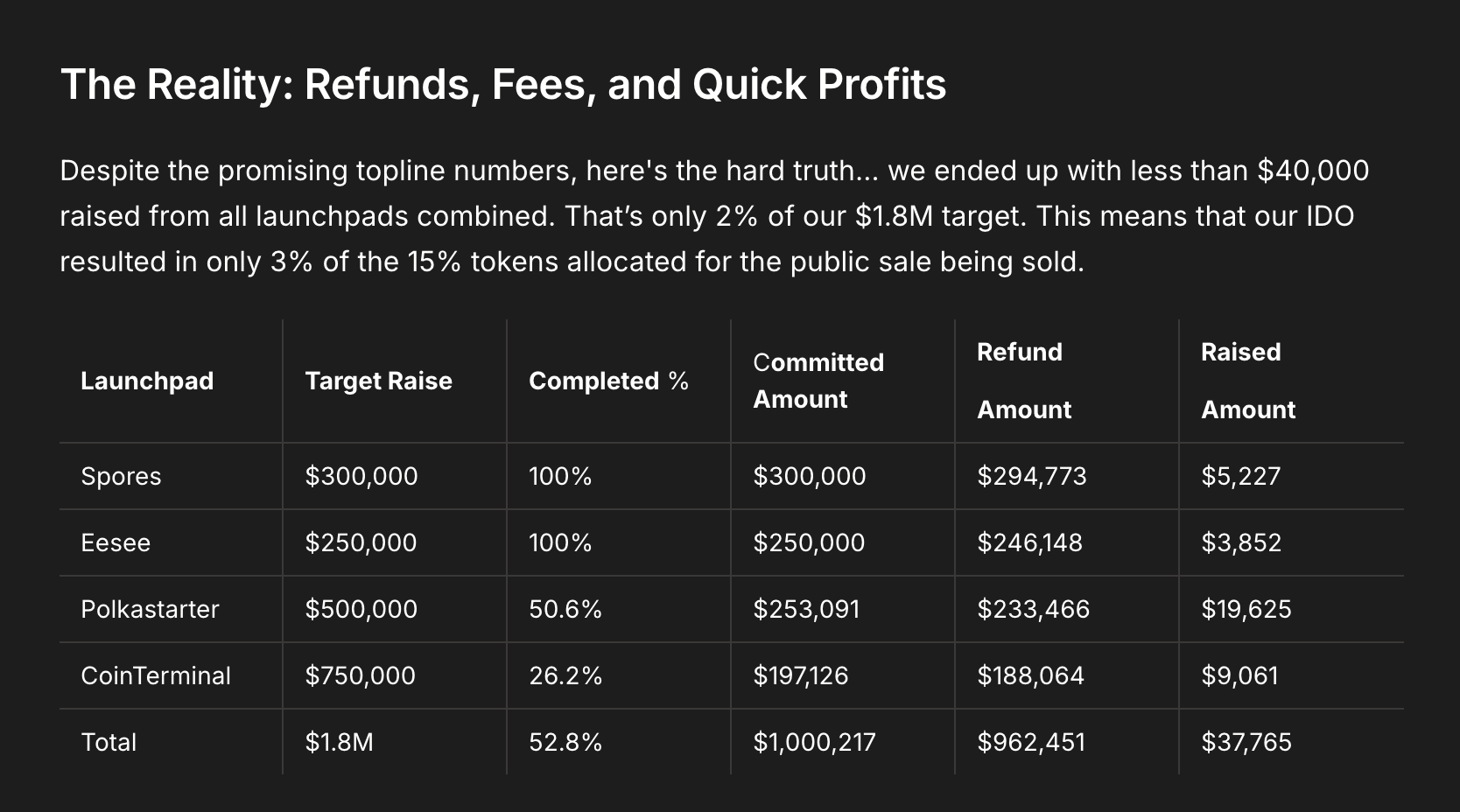
CHIPS Protocol published one of the clearest founder-side IDO reconciliations we have seen. The project ran its public sale across Spores, Eesee, Polkastarter and CoinTerminal. Its detailed table reported:
| Launchpad | Target raise | Completed | Committed amount | Refund amount | Raised amount |
|---|---|---|---|---|---|
| Spores | $300,000 | 100% | $300,000 | $294,773 | $5,227 |
| Eesee | $250,000 | 100% | $250,000 | $246,148 | $3,852 |
| Polkastarter | $500,000 | 50.6% | $253,091 | $233,466 | $19,625 |
| CoinTerminal | $750,000 | 26.2% | $197,126 | $188,064 | $9,061 |
| Total | $1.8M | 52.8% | $1,000,217 | $962,451 | $37,765 |
The column names are CHIPS’s own. “Raised amount” is what reached the project after refunds and unclaimed allocations.
CHIPS said refunds and unclaimed allocations averaged 96% across the four platforms. The project retained about 2% of its $1.8 million target and reported more than $90,000 in launchpad fees alone. In plain money terms, the launch produced a seven-figure commitment headline and left the team in the red.
This is a self-reported project account, not an audited reconciliation. The post provides the platform-by-platform table and a token-balance explorer link, but no complete set of settlement transactions. That limitation should stay visible. The disclosed gap is still large enough to change how a founder evaluates a multi-pad proposal (original CHIPS recap).
The human cost behind the settlement mechanics
Helios Blockchain described the same problem from the founder side. The team alleged that participants on several launchpads could claim the 10% TGE unlock, sell it and refund the remaining 90%.
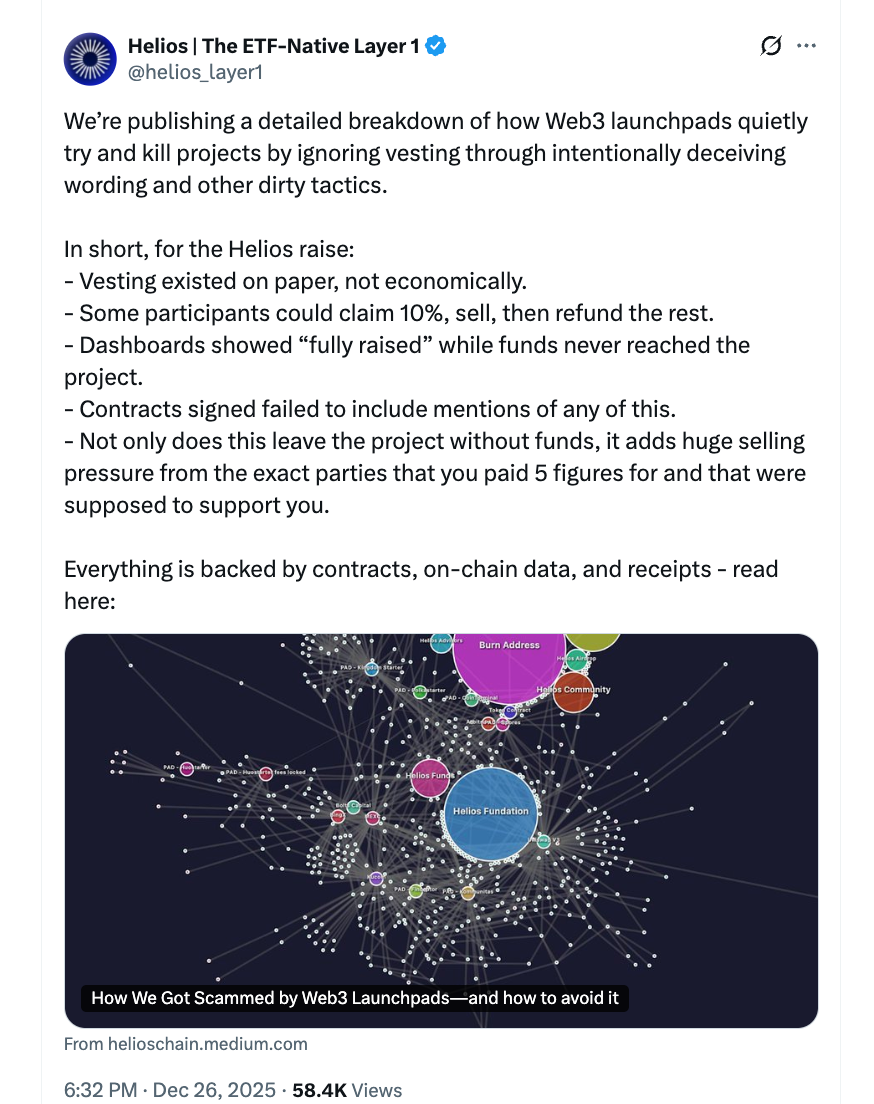
Helios said it deployed six figures of its own capital to defend the market while the public dashboards still presented rounds as fully subscribed (original X post; detailed project account).
The article includes contracts, transaction references and a reproducible wallet-analysis tool, but the allegations have not been independently adjudicated. We include it because it shows what a launchpad mechanic feels like inside the project: the team carries sell pressure, reputation risk and operating costs while the usable raise can disappear.
Helios’ closing message to other teams is worth preserving:
“Builders deserve transparency before signing, not explanations after the damage.”
MapleFi described a less detailed but similarly painful outcome. The project said it had spent more than $25,000 of the team’s own cash, excluding development, operations, legal, design and infrastructure, while the launchpad route delivered “almost nothing.”
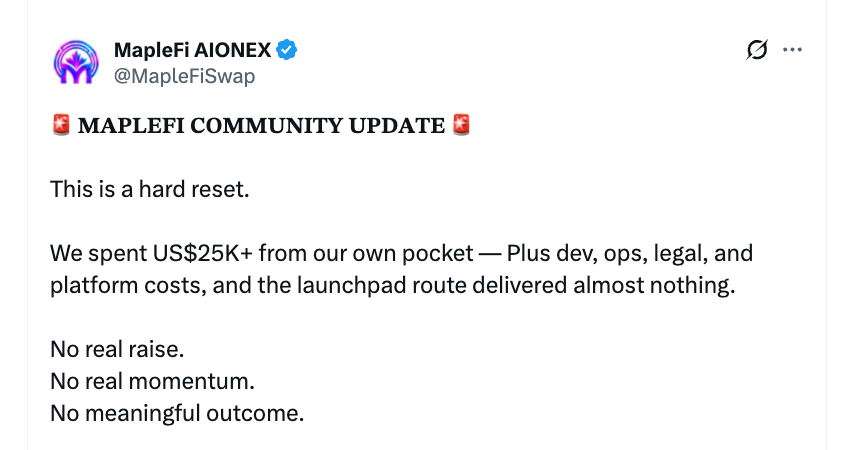
The project set out the rest in a longer post published the same week. It named the two platforms involved, BinStarter and Spore Network, and described two separate problems: a token-handling dispute with one, and, with the other, a raise figure that moved after the fact.
In MapleFi’s words: “approximately $7,000 had initially been communicated as raised, but later the position changed to effectively no meaningful raise.”
That is a different failure from the refunds above. Nothing was returned to participants. The reported number itself changed. It is the clearest illustration of why “raised” has to be defined before you sign: the same campaign can be described as a $7,000 raise or as no raise at all, depending on who is speaking and when.
As with the accounts above, this is the project’s own telling. We have not independently verified it, and we have not sought the platforms’ response. We include it because the mechanic it describes — a reported raise figure that changes after the fact — is one a founder can guard against in writing before signing.
A logo is not funding. A listing is not funding. A launch announcement is not funding.
MapleFi published no settlement table or transaction trail, so its figures cannot be used to calculate a refund rate. They can be used to remember that founder time and team-funded launch costs belong in the launchpad P&L, and almost never appear there.
Its closing advice to other founders — verify written terms, wallet control and token custody, fee structure, prior fundraising performance, and refund or non-performance terms before paying anything — arrives at almost exactly the checklist below. Projects tend to reach that list the expensive way.
What this means for a multi-pad strategy
A multi-pad strategy made sense when each additional launchpad gave a project another pool of early adopters and supporters. In the current market, adding platforms can mean distributing tokens across several groups of short-term, refund-sensitive participants while multiplying fees, deadlines, allocation rules, communications and listing pressure.
More pads do not automatically mean more distribution. Sometimes they mean more operational risk and less clarity about who actually wants the product.
Add a launchpad to a multi-pad strategy when it has a defined job: access to a relevant geography, chain, ecosystem, exchange path or provably different participant base. “They have a big community” is not a strategy.
Do you need a launchpad at all?
A launchpad is useful when it removes a real constraint. You may need one if your team has a credible product and token plan but lacks retail distribution, sale infrastructure, participant operations, community activation or experienced launch coordination.
You may not need one if you already control qualified demand and only need technical sale tooling, or if a strategic, ecosystem or exchange partner already covers the distribution job. You should delay any public sale if token utility, legal structure, valuation, liquidity or post-TGE operations are still unresolved.
Ask a blunt question before comparing platforms: What must this launchpad contribute that our team cannot produce more effectively itself? Put the answer into the agreement as measurable work. If the answer remains “exposure,” you are not ready to buy the service.
What does a crypto launchpad actually do for a token issuer?
A crypto launchpad provides the infrastructure and operational framework for distributing tokens to a public or community audience. Depending on the platform, that may include application review, sale-page setup, participant access rules, KYC coordination, allocation logic, vesting or claim tooling, marketing support, community activation and post-sale reporting.
That does not mean every launchpad does all of those things. It also does not mean the platform can guarantee a successful raise, an exchange listing, liquidity or token performance.
Founders usually encounter several launchpad models:
| Model | Best for | What you gain | Watch out for |
|---|---|---|---|
| Exchange-led IEO | Best forMature projects ready for an exchange-led process | What you gainDistribution inside an established exchange user base | Watch out forEligibility, concentration and no guarantee of secondary-market performance |
| Curated IDO launchpad | Best forWeb3-native projects with a credible product and an active community | What you gainA structured application, preparation and public sale process | Watch out forA platform-token gate that blocks the users you already have |
| Chain- or sector-native launchpad | Best forProjects deeply tied to one chain or vertical | What you gainAudience relevance and ecosystem relationships | Watch out forLimited reach outside that ecosystem |
| Incubator plus launchpad | Best forTeams still refining tokenomics and launch strategy | What you gainHands-on preparation before public exposure | Watch out forVague scope, long timelines or expensive bundled services |
| Open or self-service launcher | Best forExperienced teams with their own demand and Web3 operations | What you gainSpeed, control and lower selection friction | Watch out forYour team owns almost every failure point |
| Committed-capital launchpad | Best forTeams that need usable capital before TGE | What you gainStronger visibility into usable post-sale capital and less speculative refund exposure | Watch out forThe exact legal, custody and release conditions must be documented |
For example, Polkastarter’s founder page describes a curated application, due-diligence and council-review process followed by pre-raise, launch and post-launch support. Binance Launchpad represents the exchange-led model. AlphaMind focuses on committed, non-refundable participation where campaign terms and jurisdiction support it, with optional SmartWhitelisting and no requirement to stake an AlphaMind platform token simply to enter a campaign.
These are different products. Comparing them on follower count alone makes no sense.
The seven checks that decide a launchpad
1. Does it reach people your project cannot reach itself?
The right audience is not the largest Telegram group. It is a reachable set of participants who understand your category, can legally join the campaign, can use the required chain, and are comfortable with your ticket size and vesting.
A gaming community may not convert for infrastructure. A large retail audience concentrated in excluded jurisdictions adds impressions but no eligible participants. A platform with thousands of token stakers may be valuable — but only if those users want your project rather than an allocation to farm.
Decide what you are buying before you take a single call: validated retail demand, usable pre-TGE capital, a wider holder base, activation of a community you already have, hands-on launch preparation, or an exchange-led path. A platform that cannot explain how its process changes for your objective is selling a standard package, not a launch.
Assume a launchpad audience is speculative until campaign data shows how many participants became holders, product users or engaged community members after the sale.
Ask:
- Which three completed launches are most comparable to ours by sector, chain and sale size?
- How many unique participants joined those rounds, and how many came from the project’s own community rather than the platform?
- Which regions produced eligible participation, and which produced only traffic?
- What share of joined capital was refunded across the last five to ten comparable sales?
Red flag: the answer is total social followers, and campaign-level participation data “is not something we share.”
2. Can your community participate without buying a platform token first?
Some launchpads require users to buy, hold or stake the platform’s token before they can receive an allocation. That can create loyal platform users and predictable tiering. It can also put a new asset, new wallet step and new price risk between your project and the community you spent months building.
Neither model is automatically right. The question is whether the gate helps or obstructs your sale.
Ask:
- Must participants hold or stake a platform token?
- Are there tiers, lotteries, guaranteed allocations or FCFS rounds?
- Can our existing community enter through a project-specific allowlist?
- How many eligible users typically complete the full participation flow?
Red flag: “community size” includes users who cannot access your sale without first buying a different token.
3. When does the money stop being refundable, and who holds it until then?
This is the check that decides the others.
In a refundable sale, participants may be able to return all or part of their allocation during a defined window. In a committed sale, participation is normally final under the published campaign terms, apart from specific integrity or cancellation conditions. Other platforms use milestone-based releases or campaign-specific rules.
Do not stop at the words “refundable” and “non-refundable.” Two mechanics matter more than the label.
Is a refund the default? CHIPS Protocol reported that on some of its platforms participants had to actively claim their tokens after the IDO, and that an allocation left unclaimed was refunded automatically. A sale where doing nothing returns the money behaves very differently from one where returning the money takes a decision.
Can a participant keep part and return the rest? Helios alleged that participants could claim the 10% TGE unlock, sell it, and refund the remaining 90%. Where that is possible, the project carries the sell pressure and returns the capital.
Helios reduced it to one example. A participant deposits $10,000 but only wants $1,000 of exposure. They claim the 10% TGE allocation, sell it immediately, and refund the remaining $9,000. They end up with full exposure on $1,000 and no risk on the other $9,000. The project absorbs sell pressure as if $10,000 had been invested, and receives funding as if $1,000 had. It is a risk-free option, and the project pays for it.
- When exactly does a participant’s commitment become final?
- Is an unclaimed allocation refunded by default, or does it stay with the project?
- Can a participant claim an unlocked portion and refund the remainder?
- Who controls the funds during and after the sale, and in which account?
- When can the project access settled capital?
- What happens if TGE is delayed, the sale is cancelled, or a disclosed condition is not met?
Red flag: the sale page and the signed agreement describe the refund window differently.
AlphaMind’s Refund Gap Report reviewed the published policies of 16 launchpads and found that 12 offered some form of refund or withdrawal mechanism. Across 16 recent sales with verifiable price data during the relevant window, 11 traded below their sale price while a refund was available, giving participants an economic reason to return the allocation. The report could not audit private launchpad ledgers, which is precisely why founders should demand settlement data in writing.
Put those two findings side by side. Helios described the failure mode: if the price dips below the sale price while the refund window is open, the raise is effectively cancelled, and the project is pushed into defending the price at its own cost while participants carry no downside. Our own review found that this is not the exception. In 11 of the 16 sales with verifiable price data — 69% — the token traded below its sale price while the refund window was still open.
One project's bad week is an anecdote. Two thirds of sales is a structure.
One named founder account makes the difference tangible. Boris Povar of EYWA/CrossCurve disclosed a roughly $1.5 million public raise: $1 million reached its hardcap on AlphaMind, while about 95% of roughly $500,000 placed across two refundable launchpads was returned. He said the committed round paid for exchange listings and that the team still borrowed $100,000 from friends for one week to fund launch liquidity. The account was recorded and published with his approval, but it was not independently audited.
4. What will the project actually keep?
The useful number is not the hardcap, the allocation or the amount displayed on an announcement graphic. It is settled net proceeds.
Use this calculation:
Gross commitments − refunds or withdrawals − launchpad fees − mandatory marketing and KOL costs − distribution and operational costs = settled net proceeds
Ask the launchpad to complete that waterfall for three comparable campaigns. Make sure every term is defined. “Raised” might mean reserved allocation, paid funds, claimed tokens or capital released to the issuer. Those are not interchangeable.
Then get one commercial schedule that labels every cost as: fixed or variable; cash or tokens; mandatory or optional; due before, during or after the sale; refundable or non-refundable; calculated on target, committed or settled capital.
Two of those lines do more damage than the rest.
A fee calculated on target or committed capital means the platform is paid on a number you may never receive. CHIPS reported more than $90,000 in launchpad fees against $37,765 retained.
A fee paid in tokens puts a seller on your cap table. CHIPS reported that launchpads holding fee tokens were selling into the market after TGE, and held a larger allocation than the community that had actually bought in the IDO. Ask for the vesting and lock terms on fee tokens with the same seriousness you apply to your own team’s.
Do not compare platforms on a single percentage. A lower success fee with mandatory external spend can cost more than a higher all-in fee that includes real execution.
Ask:
- Is the success fee charged on target allocation, gross commitments or settled proceeds?
- Are deposits and setup fees refundable if the campaign does not proceed?
- Are marketing, referral, market-making or listing costs mandatory?
- What are the vesting and lock terms on any tokens paid as fees?
- Will the final retained amount be reported after the refund window closes?
Red flag: the provider celebrates “sold out” rounds but will not disclose what the founders ultimately received.
5. Who owns legal, KYC and eligibility?
A launchpad can provide technical infrastructure and coordinate service providers. It cannot make a weak or unclear token structure legally sound by putting it on a sale page.
Before launch, document who is responsible for:
- issuer and team verification;
- token classification analysis;
- sale terms and risk disclosures;
- participant KYC/KYB where required;
- sanctions and restricted-jurisdiction controls;
- privacy and data handling;
- tax, reporting and record retention;
- wallet screening and incident escalation.
Campaign requirements differ by project, participant location and jurisdiction. Get qualified legal advice for your actual structure. A launchpad claiming to “handle all compliance” without defining the boundaries is creating risk, not removing it.
6. Who is responsible on TGE day?
Distribution and liquidity are one question, because they fail on the same afternoon.
Token distribution is where launch promises become smart-contract and operational dependencies.
Confirm:
- sale allocation and per-wallet caps;
- lottery, guaranteed, FCFS or allowlist rules;
- initial unlock and vesting schedule;
- claim chain, wallet flow and gas requirements;
- whether distribution is automated or project-operated;
- support for delayed TGE or changed contract addresses;
- responsibility for wrong allocations, failed claims or incident communications.
Then get a responsibility matrix for the market side:
- DEX pool creation and ownership;
- initial liquidity source and amount;
- market-maker selection and mandate;
- CEX application or coordination;
- timing between token claims and trading;
- bridge or swap requirements;
- price-discovery and volatility contingencies;
- communications if listing or liquidity timing changes.
Your tokenomics deck, sale page and deployed contracts must describe the same reality. If vesting exists only in a PDF and not in the actual claim logic, the launch has a structural problem.
“Exchange support” is not a confirmed listing. “Liquidity support” is not someone accountable for liquidity on launch day. Treat a guaranteed listing, guaranteed liquidity or guaranteed price as a warning rather than a selling point. Good partners make dependencies visible; they do not pretend the dependencies are not there.
7. What work is in scope, and can they prove what it produced?
“Full marketing” is not a deliverable. What you need is a campaign plan with owners, dates, formats and approval deadlines — and a way to tell afterwards which of it worked.
Separate the work into four columns:
| Workstream | Launchpad owns | Project owns | Shared |
|---|---|---|---|
| Positioning and token education | |||
| Sale page and technical setup | |||
| Content and announcements | |||
| AMAs and founder appearances | |||
| KOL and partner activation | |||
| Community moderation | |||
| KYC and participant support | |||
| Liquidity and TGE operations | |||
| Post-sale reporting |
Then the proof. Likes and impressions do not tell you who reached the sale, connected a wallet, passed the required checks or committed funds. Ask for reporting by source and by partner across the whole path:
Visit → wallet connection → eligibility/KYC → allowlist or quest completion → allocation → purchase → refund/claim → settled participation
The reporting does not need to expose personal data unnecessarily. It does need to help the project distinguish a partner that produced attention from one that produced qualified participation.
No credible launchpad can compensate for a founder who disappears during the campaign. Your team still needs a clear narrative, fast approvals, usable assets, responsive leadership and honest communication when conditions change.
Red flag: every KOL receives a tracking link, but the final report contains only total traffic and total raise.
Four automatic no-go conditionsThe written agreement does not match the refund, claim or funds-release flow.The provider will not identify who controls issuer funds and when they move.A guaranteed raise, listing, liquidity outcome or token price is part of the sales pitch.Mandatory cash, token or partner costs are disclosed only after commercial commitment.
Founder shortcut: shortlist no more than three platforms. Ask each one to complete the same data request. Comparable answers reveal more than another week of sales calls.
Get an AlphaMind launchpad fit review →
Share your current deck and launch assumptions. Applying is free, creates no launch commitment and gives our team enough context to assess fit.
Copy-and-send data request for every shortlisted launchpad
Do not let every provider choose its own success metric. Send the same request to all of them:
Please share campaign-level results for your last ten completed sales and identify the three most comparable to our project by sector, chain, stage and target size. For each comparable sale, provide: gross committed amount; amount claimed; amount refunded or withdrawn; fees charged and their calculation basis; net funds transferred to the project; transfer date; number of unique participants; share of participation attributed to the project, launchpad and external partners; and any post-TGE holder or user-retention data you track. Please also provide the current refund, custody, claim and funds-release terms that would apply to our campaign, plus a complete list of mandatory cash and token costs.
Silence is also data. A launchpad may have a legitimate confidentiality constraint, but it should still be able to provide anonymized ranges, definitions and references from founders who have agreed to speak.
Three questions the data request does not cover, and you should ask on the call:
- How many announced campaigns actually proceeded, and how many were quietly dropped?
- Were delays, cancellations and changed terms disclosed publicly at the time?
- Can we speak to two recent founders without your team on the call?
Historic token ROI is a weak selection criterion on its own. It is driven by market timing, initial float, valuation, liquidity and the moment you choose to measure, and it rewards structures that produce a short-lived chart rather than a healthy launch. A $5 million headline on an incomparable campaign is less useful than a transparent $300,000 outcome for a project with your stage, audience and constraints.
What should your project prepare before approaching a launchpad?
A strong launchpad cannot manufacture readiness after the campaign has started. Before applying, prepare a consistent founder package containing:
- a concise product and token thesis;
- current product status and measurable traction;
- verified team and company information;
- deck, website, documentation and technical materials;
- token utility, allocation, valuation and vesting;
- target raise and use of funds;
- legal analysis and target/restricted jurisdictions;
- smart-contract status and audits where applicable;
- community size and engagement quality;
- ecosystem, KOL and distribution partners;
- TGE window, chain and distribution plan;
- liquidity and market-maker status;
- named owners for content, community, legal and technical work;
- a realistic calendar for approvals and founder appearances.
The project story also needs to survive contact with a retail participant. If a qualified user cannot understand what the product does, why the token exists, what unlocks at TGE and what the major risks are, more traffic will not fix the sale.
Use AlphaMind’s Token Sale ROI Calculator to stress-test how sale price, initial circulation and listing valuation may look from the participant side before you submit the campaign.
Worked example: the smaller headline can produce the better outcome
Consider two hypothetical campaigns. These numbers are illustrative, not performance forecasts.
Illustrative — not a forecast
| Campaign A Refundable allocation | Campaign B Committed sale | |
|---|---|---|
| Announced / gross commitments | $500,000 | $300,000 |
| Refunds or withdrawals | −$375,000 | $0no speculative refunds* |
| Capital remaining | $125,000 | $300,000 |
| Success fee | −$50,000 | −$30,000 |
| Required campaign costs | −$30,000 | −$30,000 |
| Net proceeds | $45,000 | $240,000 |
9% of the headline |
80% of the headline |
*A committed sale can still require refunds if the campaign is cancelled or specified integrity conditions apply. Exact rules depend on the contract, jurisdiction and sale terms.
Campaign A produces the better announcement: “$500,000 committed.” Campaign B gives the project more usable capital under this scenario.
Neither structure guarantees a good outcome. The decision has to be based on participant behaviour, settlement mechanics and realistic net proceeds. The headline raise is not enough information to choose a launchpad.
How AlphaMind fits this decision framework
AlphaMind is designed for Web3 founders who want to validate and convert retail demand before TGE through committed sale mechanics, campaign infrastructure and founder-side visibility.
For a deeper explanation of the model and its limits, see What Is a Non-Refundable Crypto Launchpad?.
Depending on the approved campaign scope, AlphaMind can support:
- transparent non-refundable participation terms where the legal and operational structure supports them;
- access to raised capital after the sale rather than holding it until TGE, under agreed settlement terms;
- participation without requiring users to buy or stake an AlphaMind platform token;
- optional SmartWhitelisting to measure pre-sale intent;
- quests and community education;
- KOL and referral attribution closer to wallet and purchase behaviour;
- EVM and campaign-specific multichain planning;
- launch preparation, sale infrastructure and founder-side reporting.
AlphaMind’s first IDO with EYWA/CROSS reached a $1 million hardcap (original confirmation from the project). That is historical proof that the platform can execute a serious retail campaign when the project, market, community and timing align. It is not a promise that another campaign will achieve the same result. Founders can review AlphaMind’s public launch archive rather than relying on a single headline.
AlphaMind may be a strong fit when
- your project has a credible product or ecosystem context;
- the token role and sale terms can be explained clearly;
- you have a real community, partners or identifiable demand sources;
- you want to measure commitment rather than vanity engagement;
- your team is ready to promote the campaign and respond quickly;
- you value referral attribution and founder-side reporting;
- you need a tailored launch proposal rather than a self-service sale page.
AlphaMind is probably not the right fit when
- you expect a guaranteed raise, exchange listing, liquidity or token price;
- the token utility, legal structure or participant terms are unresolved;
- the team expects the launchpad to replace all founder-led marketing;
- there is no realistic TGE, liquidity or distribution plan;
- the campaign depends on claims that cannot be supported publicly.
AlphaMind provides launch infrastructure and campaign support. Project teams remain responsible for their token terms, legal compliance, participant eligibility, liquidity plan and post-sale execution. Commercial terms depend on campaign scope and are discussed after project review.
Frequently asked questions
What is the best crypto launchpad for a new project?
The best crypto launchpad is the one that fits the project’s stage, audience, chain, sale model and operational needs. Early teams may need incubation; later-stage teams may prioritize exchange distribution; projects with an existing community may benefit more from open access, committed sale mechanics and clear attribution. Compare evidence using one scorecard instead of relying on a generic ranking.
How much does it cost to launch a token on a launchpad?
Launchpad costs vary by campaign and may include setup fees, retainers, success fees, token allocation, marketing spend, referral commissions or technical services. Ask for an all-in commercial schedule showing which costs are fixed, variable, mandatory, refundable and calculated on target versus settled capital. Do not compare providers using one percentage alone.
What is the difference between an IDO, IEO and ICO launchpad?
An IEO is distributed through a centralized exchange platform. An IDO is generally associated with decentralized or on-chain token distribution, often coordinated by a specialist launchpad. An ICO is a broader issuer-led token offering and may not use an exchange or curated launchpad. Actual mechanics and legal treatment depend on the campaign and jurisdiction.
Do crypto launchpads guarantee a successful token sale?
No credible launchpad can guarantee fundraising results, an exchange listing, liquidity, token price or secondary-market performance. A launchpad can provide infrastructure, audience access, campaign design and execution support. Results still depend on project quality, token terms, valuation, market conditions, founder effort, community demand and post-sale execution.
Do buyers have to stake a launchpad token?
On some platforms, yes. Staking may determine eligibility, tier or allocation size. Other launchpads allow project-specific access without requiring a platform token. Founders should measure whether a staking gate brings a qualified audience or prevents their existing community from participating.
The best launchpad is not the platform with the loudest announcement. It is the one whose audience, mechanics, economics and execution model still make sense after the excitement is removed.
Apply for an AlphaMind launch review →
Sources and methodology
- CHIPS Protocol — IDO Recap: platform-by-platform reconciliation of committed, refunded and retained capital across four launchpads, published August 2025
- Helios Blockchain — original X post (26 December 2025) and the detailed account of partial claims, refunds and founder-funded launch costs
- MapleFi — community update on X (10 July 2026) and the full strategic reset post, reporting US$25,000+ of team-funded cost against approximately no meaningful raise
- AlphaMind — Refund Gap Report: 16 launchpad policies read in full, 21 sales traced, 16 with verifiable prices; includes methodology, limitations and conflict disclosure
- EYWA / CrossCurve — the project’s own confirmation of the $1 million community round on AlphaMind, 5 December 2024
- Polkastarter — Launch your project
- Binance — Binance Launchpad
A note on method. Every case above is a project’s own published account, linked in full. We have not audited them, and we have not sought responses from the platforms named in them. Nothing here is an allegation by AlphaMind, and a platform that appears in one project’s account is not being characterised beyond that campaign. AlphaMind operates a launchpad and competes with several of the platforms mentioned.
Platform features, terms and statistics can change. Verify current details directly with each provider. This article is educational and does not constitute financial, investment, tax or legal advice.